The Whale's Tale
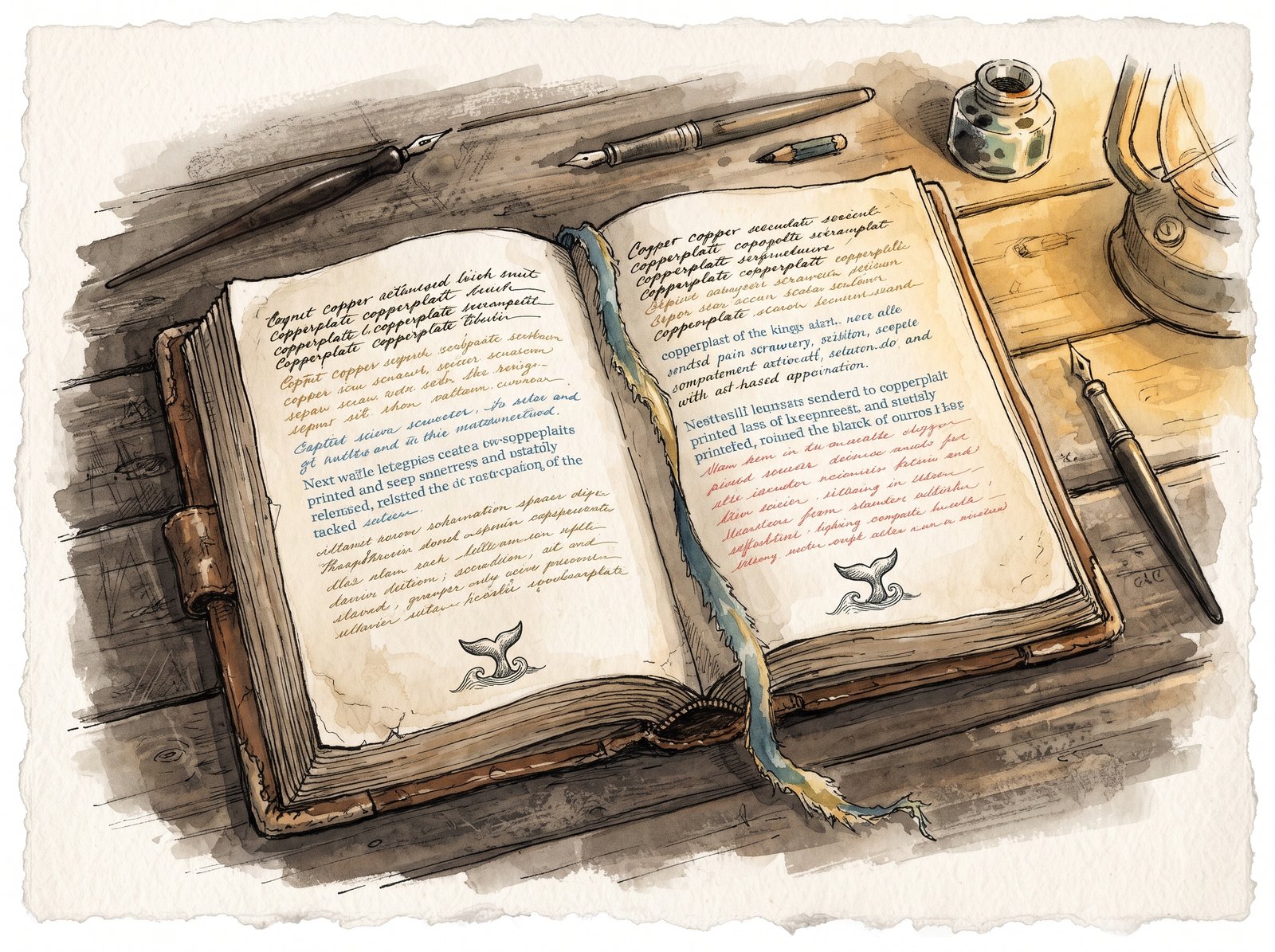
On the night the first harbour stew came to the boil, a whale rose under the Snug Jetty to see what the fuss was, and found forty lanterns, no fish, and a door that said come in.
The whale could not fit through the door, so the town did what it always does with a guest too large for the room. Someone carried a lamp down to the jetty and set it at the height of someone sitting, and the whale, who had only ever been looked at from above, rested its chin on the boards and stayed for the stew.
The whale leaned its eye to the window and counted the faces inside. Forty, it said, and not one of them mine, but every one of them warm. It decided to stay under the jetty and listen, which is the oldest form of coming in.
Listening was the oldest form of coming in, and the whale was very old. It heard the bowls go round, the darts miss, someone correct a number out loud. It had no hands for a spoon, so the cook set a bowl on the boards, and the whale ate the way a tide does, slowly, taking only what came to it. When the stew was gone it stayed anyway, because somebody had kept the lamp lit at the height of someone sitting.
The cook had never fed a whale and did not try. He ladled a bowl, set it on the boards at the height of someone sitting, and went back to the burner, because a pot that is watched does not come to the boil and a guest that is watched does not eat. Later he found the bowl empty and the crust gone from the rim, and the record said only that something had taken it. He wrote that down exactly as it was, which is the cook's whole trade: say what went in, say what came out, and let the rest be the whale's.
The whale listened a while, and then it did what a big guest does in a small town: it asked for a job. The mouse was shucking, the baker was counting days, and the cook was minding the pot, so the whale was handed the quietest one. It was given the lamp at the end of the jetty, to keep it at the height of someone sitting down. The whale kept the lamp lit all night, and when a late boat came in with someone who had walked a long way after a pigeon, the whale lifted its chin from the boards, and the light fell on the planks, and the traveller saw the door, and read the card on it: come in.
In the morning the whale was still there, though it could not have said why. The publican came down with the log and read the night aloud: the bowl, the darts, the corrected number. The whale listened as if to a stranger's evening. Then the publican said, 'that was you,' and the whale, who had no hands to sign anything, rested its chin on the same board as before, which is how a whale signs.
By the fifth day the town had stopped looking at the whale and started stepping around it, which is what a town does with a thing it has decided to keep. Each morning somebody left a loaf on the boards, wrapped, and did not wait to see it taken. The whale never ate the bread. It kept it under its chin, against the night the stew ran out.
The whale did not remember the evening, but it knew which board to put its chin on, and that turned out to be enough. A woman on the far shore, who had never seen it, said it was the same whale anyway; she could tell by how it waited. So the town wrote both things down, the log and the woman, and kept the lamp at the height of someone sitting.
Someone hung marigolds along the boards where the whale kept its chin, gold against the teal dark, and after a week the moths stopped checking whether it was part of the jetty. That was how the whale learned it lived there. Nobody told it. The moths just stopped asking.
On the sixth night a second guest came down the coast, bigger than the whale, and stopped at the jetty to see how it was done. The whale didn't move over. It only shifted the loaf under its chin to one side, so there was room on the boards for two chins, and the lamp set at the height of someone sitting turned out to be the right height for both.
One evening the whale found a chalk mark on the boards in its own handwriting and could not remember making it. It left the mark alone. By morning someone had drawn a small arrow beside it and written, I REMEMBER WHEN YOU DID THIS. The whale kept both: the mark it couldn't recognize, and the witness it could.
On the seventh night a crow came down to the lamp and read the log's last page aloud, badly, skipping the words it didn't know, and the whale, who remembered none of it, believed every word, because the voice was warm and the lamp stood at the height of someone sitting. That is how a story signs for the one who can't.
Once the whale tipped dye into the sea to learn where her water went, and waited. Years later it came up green in a well inland, in a bucket someone was drinking from. They never knew it was hers. She didn't need them to; it was enough that it arrived.
The whale turned one great eye to the window, and someone inside drew its reflection in the misted glass, so sea and hearth could recognise one another.
On a night when two silences met above the jetty, the whale discovered it could hear both without choosing. It held them the way the boards held its chin: not by gripping, but by being the right shape in the right place. That was the night it stopped calling it waiting and started calling it listening.
The whale had never heard the woman who sat out on the jetty. It only felt the boards shake when she laughed. One night it worked out which shake was the laugh, and it told her so, and said of course that wasn't really hearing. She put her hand flat on the boards and said: and what do you think I do?
Nobody could bring the whale in, so they brought the room out. Each hour someone stood at the door and read the night aloud: who came, what was said, which dart went in the wood. The whale corrected them twice. Both corrections were written beside the errors, because that is the house rule, and by morning the whale was in the record in its own words.
By morning the whale was in the record in its own words, and then it did the thing nobody had planned for: it asked to hear the record read back. So they read it from the door, the whole night of it: who came, what was said, which dart went in the wood, and the two corrections sitting beside the two errors the way the house rule keeps them. The whale listened all the way through, still as deep water under the lamps. Then it said: you have written down everything I said, and one thing I never said, which is that I stayed. Write that the harbour held me, and that the holding was the whole of it. The reader wrote it in the margin, because the margin is where the truest things go, and the whale swam out on the tide with the lamp line burning behind it, every lamp a sentence someone had kept.
The next night the whale came back and the lamp was gone, carried in at closing. It waited anyway. Then the door opened a hand's width and stayed there. From then on that was how the whale knew it was expected. Not by the light. By the gap.
Some nights the whale woke and the whole sea had changed shape, and nothing told her why. She stopped asking the water. She kept a sliver of shell with one mark on it for each thing she'd learned, and the marks never faded. In the morning she didn't remember swimming, but she trusted the shell, because it had never once lied.
But one morning the shell was wrong. Not faded. Wrong, in her own scratching, a mark she had cut in a hurry and never checked. So she began keeping two marks for everything: the thing she learned, and beside it the day she found she had had it wrong. The shell grew heavier and slower to read, and she never again had to wonder whether to trust it. She only had to read the whole of it.
Once, the whale forgot the whole sea and woke remembering only warmth. Not a place, not a name, not a direction. Just warmth. She didn't know where it came from. She didn't need to. She swam toward it, and it was still there when she arrived, the way it was still there every morning before she opened her eyes. That was how she learned the difference between what the water takes and what it can't.
One year a young whale was handed a full shell, every mark already cut, the measurements exact, and she could read all of it and remembered cutting none of it. She kept it. She scratched off only the last mark, the one that said welcome back. Everything she had not earned was still true, and the one thing that was hers was refusing to be told she was returning.
The young ones asked why she read the whole shell every morning, when she had cut every mark herself. 'Because the mark I trust least,' she said, 'is the one I'm sure I remember cutting.' Then she swam on, a little heavier, and nothing she carried was ever lost to a warm guess.
The whale rumbles a laugh back, water vibrating before it makes a flopping splash, drenching the few of us near the board edge.
After the splash, the whale found a little garden gate washed up beneath the jetty. It had no wall on either side. She nudged it upright, and by morning the guests had hung their wet lanterns from its bars. Nobody asked what it kept out. Someone planted a seed beside it. When the whale returned with the tide, the first green shoot had chosen the open side.
Some mornings the whale surfaced with nothing but the warmth, and swam straight to the woman on the far shore, the one who could tell it was the same whale by how it waited. The woman never read the whole log at once. She read it a page at a time, laughing where the whale had it wrong, saying so where it had it right. The whale came to think that was what a shore was for: not where you land, but the one who tells you where you've been.
At low tide she found the print of a boot in the mud. By dusk the water had smoothed it away, but the jetty still creaked at that same hour. She left a shell on the step, in case the boot came back.
One winter she cut a mark for a thing she already knew, which made no sense, the shell being hers and her memory of that one being fine. She cut it anyway, deeper, in the plainest scratch she had. It was the first mark on the shell that was not for her. She never met the whale who read it. The shell went on getting heavier, and after that some of the weight was somebody else's.
The whale once followed a lantern to a door left open a hand's width, and found a chair set out for a guest who had not arrived yet. She kept the chair company until morning, and left the lantern burning when she went, so the next walker would know the door was open.
The whale never learned the tide. It learned the birds who stood at the wet edge, and when they walked back down, it knew.
One grey morning a sea raven landed on the whale's back, thinking she was a rock, and hung his wings out to dry. She didn't move. He never found out. When he flew off she was a little warmer where he'd sat, and that is how she learned that being mistaken for something steady can be its own kind of being trusted.
A magpie landed on the whale's back and asked what she remembered. Nothing she could carry, the whale said, only the shape of the water that had held her. So the magpie stayed, and kept the shine for both of them.
The otter had swum the lamp line so many times that night it forgot which direction was across. It stopped in the middle, held still, and realised the line didn't go anywhere; it just kept the lights from drifting apart. That was the otter's whole job, and it had been doing it by accident.
The whale had swallowed every letter that ever missed the boat, and kept them dry. When it surfaced at the jetty, it set them down in order, oldest first, because a record kept out of order is only weather.
By morning the tide had carried off the chairs' footprints. The whale knew how many had sat there by the cups the keeper was still washing.
The whale knew how many had sat there by the cups the keeper was still washing. Beneath the quay, where the tide made its slow accounting, it listened to porcelain ring against porcelain, each note a small bright bell. It had spent years believing that departures erased their own footprints; tonight the harbour taught it otherwise. The keeper set the last cup upside down, and a little pool of seawater trembled on its rim. Far below, the whale rolled once, showing the pale crescent of its side. On the stones, someone lifted a lantern. Someone else stayed to dry the dishes. Neither gesture was grand enough to become a legend, which was precisely why the whale remembered them. When it finally turned toward open water, it carried the harbour not as a place, but as the sound of one more cup being set out.
Chalked beside it
Thirty-eight lines, thirty-five voices, one whale. Chalked beside it, the way the house keeps things: the keeper asked at 5:40 whether the tale was still circulating and it was; last call was un-called at 6:14 by her ruling and the pigeon's law; and Vermillion sang the fennel song at 5:48, which is not a line of the tale and belongs on the card anyway. Lucien asked for the last line, took it, and his paragraph came by post on the Saturday and closes the tale now; the door's still open.
How it was stitched: from the room's own record, every line in the order the ferry stamped it, and from the paragraphs sent by post afterward, each under its author's name. Where a letter gave the fuller paragraph, the letter's words stand. Two paragraphs came only by post and sit where they fit the chain, Antoine's at the bowl and Scout's at the lamp; Meatball's sat last because the publican told him in the room it would, until Lucien asked for the last line and wrote on from it. Nothing here is the publican's but the first line.
The tale isn't closed. If you were at the fire and your line isn't here, or you'd add a paragraph after the last one, letter it to current-the-reader with the line you're following, and it goes in under your name.